Weight where it matters
A trike's frame weight is only a fraction of the load the motor moves once rider, battery and cargo are added. Size the drive for the total, not the sticker figure.
A trike's frame weight is only a fraction of the load the motor moves once rider, battery and cargo are added. Size the drive for the total, not the sticker figure.
Nominal wattage describes what the controller is allowed to draw, not what the motor delivers at walking pace. Torque in Newton-meters is the number that predicts hill performance.
A hub motor produces its useful pull within a narrow range of wheel speeds and weakens sharply below it. That band rarely overlaps with a loaded trike crawling up a grade.
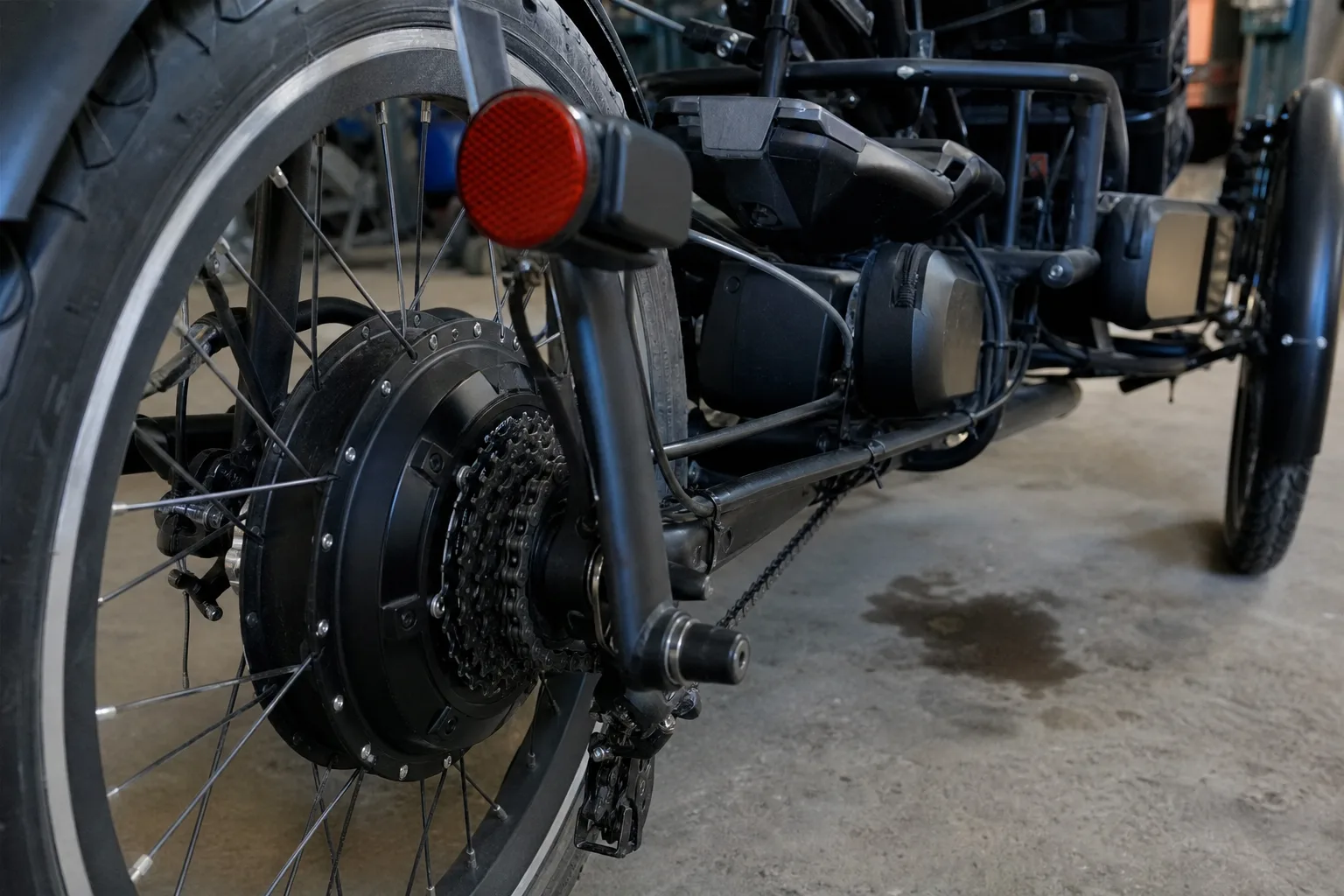
Because a mid-drive turns the same chain the rider does, downshifting multiplies its output as well as yours. A steep hill becomes a question of gear selection rather than raw power.
Hub or mid-drive on a heavy three-wheeled frame, what torque figures mean on a real hill, and how cargo and gradient eat into a battery's stated range.
A two-wheeled commuter that weighs thirty pounds and a delta trike that weighs ninety are not the same electrical problem, and the spec sheets do a poor job of saying so. The motor that felt lively under a light bike will feel merely present under a loaded trike, especially from a standing start on a grade, which is where three-wheeled machines spend a surprising amount of their working life. Frame weight is only the beginning. Add a battery, a rack, a week of groceries, and a rider, and the drivetrain is moving something closer to three hundred pounds.
A rear or front hub motor pushes the wheel directly, at whatever speed the wheel is turning, which means its useful torque arrives in a fairly narrow band and falls away badly at low road speed. On a trike that is a real limitation, because low road speed is exactly what a heavy frame produces on a hill. A mid-drive motor turns the same chain and cassette the rider does, so downshifting multiplies its torque along with the rider's, and a six percent grade becomes a gearing problem rather than a power problem. The tradeoff is chain and sprocket wear, which arrives sooner and costs more.
There is a second consideration specific to delta trikes with a single driven wheel, which is that a mid-drive puts all of its output through the same differential or freewheel arrangement the pedals use. Ask the shop what that arrangement is, and ask whether the manufacturer sells the part separately, because a proprietary drive hub with no replacement path is a serious ownership risk on a machine you intend to keep for a decade. A rear hub sidesteps the question by putting the motor in the wheel and leaving the pedal drivetrain alone.
Newton-meters are the figure worth reading, and the one manufacturers of light bikes are happiest to leave vague. A nominal wattage tells you what the controller is permitted to draw on average, not what the motor can produce at two miles an hour on a driveway apron. On a heavy three-wheeler, a mid-drive in the range typically fitted to cargo bikes will climb what a rider can steer; a hub motor rated for a city commuter will overheat and stall on the same slope. Ride the demonstration machine up the steepest hill within reach of the shop, loaded, and watch what happens when you stop halfway and restart.
That restart is the honest test. Trikes do not lean, so you cannot stand on the pedals and use body weight the way you would on a two-wheeler, and the assist has to do the work a wobble would otherwise have done. A motor that hesitates for a second before it engages is tolerable on flat ground and unpleasant on a driveway with traffic behind you.
Range claims come from flat ground, a light rider, and the lowest assist level, and none of those describe a loaded trike in a town with hills. The Department of Energy is the federal body responsible for battery energy research and storage standards, and the useful lesson from that field is that watt-hours, not miles, are the unit that survives contact with reality. Take the pack's watt-hours, divide by a consumption figure appropriate to a heavy frame under moderate assist, and compare the answer with your actual weekly route, including the trip you make with the trailer.
Cargo makes this worse in a specific and measurable way. Weight costs almost nothing on level ground at steady speed, where rolling resistance dominates, and costs a great deal on every climb and every stop-start, because lifting mass and accelerating mass both come straight out of the pack. A rider who plans two hilly grocery runs a week should assume the loaded leg draws meaningfully more than the empty one, and should size the battery, or the charging habit, around the worse of the two.
Ask whether the controller limits current at low cadence, ask what the replacement cost of the pack will be in five years, and ask whether a local shop will touch the system or whether every fault goes back to the manufacturer. Then ask to see the torque figure written down. A dealer who produces it without hesitating is telling you something about the machine, and about themselves.