Delta layout defined
A delta trike has one wheel at the front and two at the rear, with the single wheel doing the steering. The seat is usually upright and comparatively high off the ground.
A delta trike has one wheel at the front and two at the rear, with the single wheel doing the steering. The seat is usually upright and comparatively high off the ground.
A tadpole trike has two steered wheels at the front and one driven wheel behind. The rider normally sits low and reclined between the front wheels.
American streets are usually built with a crown so water drains toward the curb, which puts a constant side slope under anyone riding near the gutter. A trike cannot lean to cancel it, so the rider corrects instead.
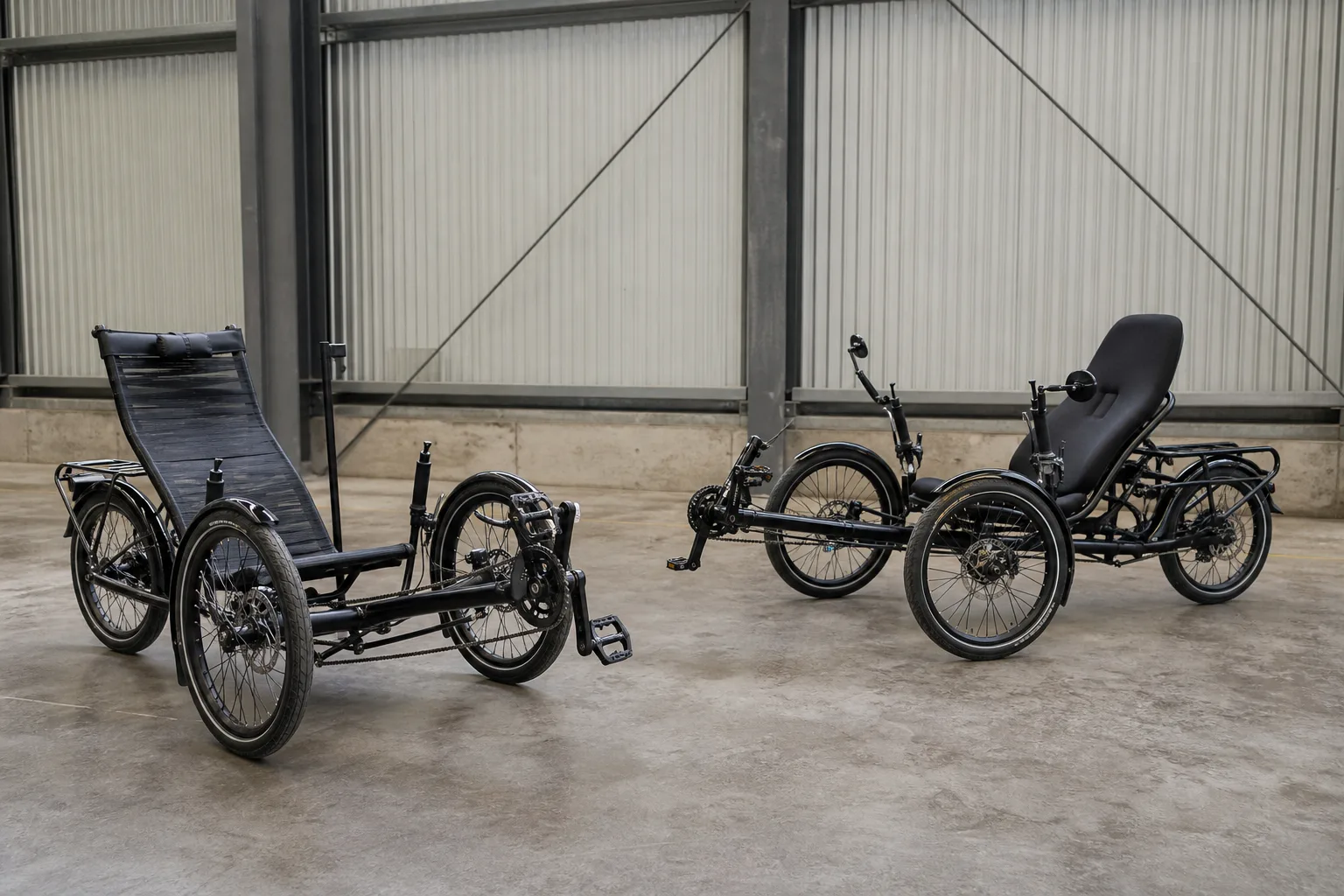
Small camber corrections are easy for a block and tiring for an hour. Judge steering effort on a long stretch of curbside riding, not a lap of the parking lot.
How two front wheels or two rear wheels change the way a trike behaves on side slopes, in turns and under braking, and what to feel for on a test ride.
Most American streets are built with a crown, a slight rise down the center that sheds water toward the curb. On two wheels the crown is invisible, absorbed by the lean angle the rider is already making without thinking about it. On three wheels it becomes a permanent, low-grade side slope that pulls the machine toward the gutter for the length of every block. Which layout you have decides how much of that pull reaches your hands, and how much of it you have to correct.
A delta trike carries one wheel in front and two behind, so the single steered wheel sits at the high end of the frame and the pair of driven wheels sits at the low end. On a crown, gravity tugs the whole mass downhill, and because the steering wheel is unloaded relative to the pair, the front wants to wander down the slope. The correction is small but continuous. A tadpole trike reverses the layout: two steered wheels in front, one driven wheel behind. The downhill pull is split across a wide steering pair, which resists it more directly, and the effort at the bars is usually lower and steadier.
None of that makes either layout unrideable on a camber. It changes what the ride feels like over an hour. A rider who commutes along a road with a pronounced crown and a bike lane pinned to the curb will notice the difference within the first mile, and a rider on flat, freshly graded pavement may never notice it at all. The honest way to find out is to ride the same block on both machines, in the same direction, near the curb rather than out in the lane.
In a turn, a trike does not lean, so cornering force transfers weight to the outside wheels while the inside wheel lightens. On a delta, the single front wheel is doing the steering while the load shifts across the rear pair, and a brisk turn at speed can lift an inside rear wheel before the rider expects it. On a tadpole, the outside front wheel takes the load and the low seat keeps the center of mass close to the ground, so the same corner at the same speed feels flatter and more planted.
Braking follows the same logic. Weight moves forward under braking, which means a tadpole puts load onto the two wheels that already carry the brakes, and stops in a straight line without drama. A delta with only a rear brake, or with an underweighted front wheel, can feel vague. Check what brakes are fitted where, whether the two front rotors on a tadpole are mechanically balanced, and whether hard braking on a camber pulls the machine toward the gutter or holds its line.
Three measurements decide most of what happens after the purchase. Track width, the distance between the outer wheels, sets both stability and whether the machine clears a bollard, a bike lane, or your own gate. Seat height sets how easily you get on and off and how far the mass sits from the road. Turning circle sets whether a U-turn on a residential street takes one movement or three. Deltas generally sit tall with an upright seat and a wide swing; tadpoles sit low with a tight circle.
Measure them yourself rather than trusting a spec sheet, with a tape across the tires at ground level and a second measurement from the pavement to the top of the seat pan. Then ride a full circle in an empty lot and pace it out. The Consumer Product Safety Commission is responsible for the safety standards that apply to bicycles sold in the United States, but no standard tells you whether a given trike turns inside your own driveway.
For short errands with frequent stops, a delta earns its keep: the upright seat makes traffic easier to see over, the higher seat is easier to step off at a light, and the rear pair takes a rack or a box directly above the axle. For longer rides, a tadpole's low seat, reclined back support and steadier line on a cambered shoulder pay off over distance. Ride each one loaded, with whatever groceries or panniers you would normally carry, because an empty trike tells you very little about a full one.
Take both machines onto the worst pavement near the shop rather than the smoothest, and give each one a curbside block, a hard stop and a U-turn. Whichever layout leaves your hands relaxed at the end of it is the one to buy.